Introduction
Why I Wrote This Booklet
For a brain like mine, completion needs to live in a physical and irreversible place rather than in memory, on a screen, or in a feeling.
This small shift changed the way I handle tasks.
This booklet is not a guide to managing ADHD. There are already many good ones written by people far more qualified than me. It is also not a productivity system with steps, phases, or a weekly planner.
What it is, instead, is a personal account of something I stumbled into, tested for nearly a year, and found to be the most stable behavioral structure I have experienced after a lifetime of trying and failing with everything else.
My name is Louis. I am a graphic designer. I was diagnosed with ADHD at 42 and later with Asperger’s at 43, a diagnosis now generally included under autism spectrum disorder. In the years since, I have tried to understand how my brain works and why nothing I tried ever lasted.
This booklet describes the shift I eventually arrived at.
I will explain what I do, show you what it looks like, outline why I think it has held, and be honest about what it cannot do.
It is short on purpose. For a brain like mine, shorter means more likely to be finished.
1: What I Found
For most of my life, I couldn’t make any habit system stick. I tried app after app, paid for more than a few, and always started with the same expectation: this one will be different. They all worked for a little while. Then they didn’t. Every time one faded out, I was left wondering why something that worked for so many people couldn’t work for me.
After being diagnosed with ADHD at 42, and later with Asperger’s at 43, I spent a long time trying to understand why. Not why I lacked discipline. I had heard that explanation enough. What I wanted to understand was why the structure itself kept collapsing.
What I kept coming back to was this: the things I did kept disappearing. Not because I stopped doing them, but because nothing in the system was built to hold them. A checked box could be unchecked, a streak could be reset, and an app could be deleted. Once the record was gone, it was as if the effort had never happened. My actions had nowhere to survive.
What I found, after almost a year of living with it, was that when I gave my actions a place to survive, a physical and irreversible place, the system stopped collapsing.
One completed session meant one LEGO brick snapped onto a baseplate. The brick is there. It does not need my memory to confirm it or my motivation to sustain it, and it does not disappear when I have a bad week. It is a fact in the world. Facts do not require maintenance.
This is not a productivity hack or a clever trick that makes you more efficient. It is a slow and unglamorous way of moving through life.
That’s what I found. The rest of this booklet is about why I think it holds, where it doesn’t, and what you might take from it, even if you never touch a LEGO brick.
2: What I Actually Do
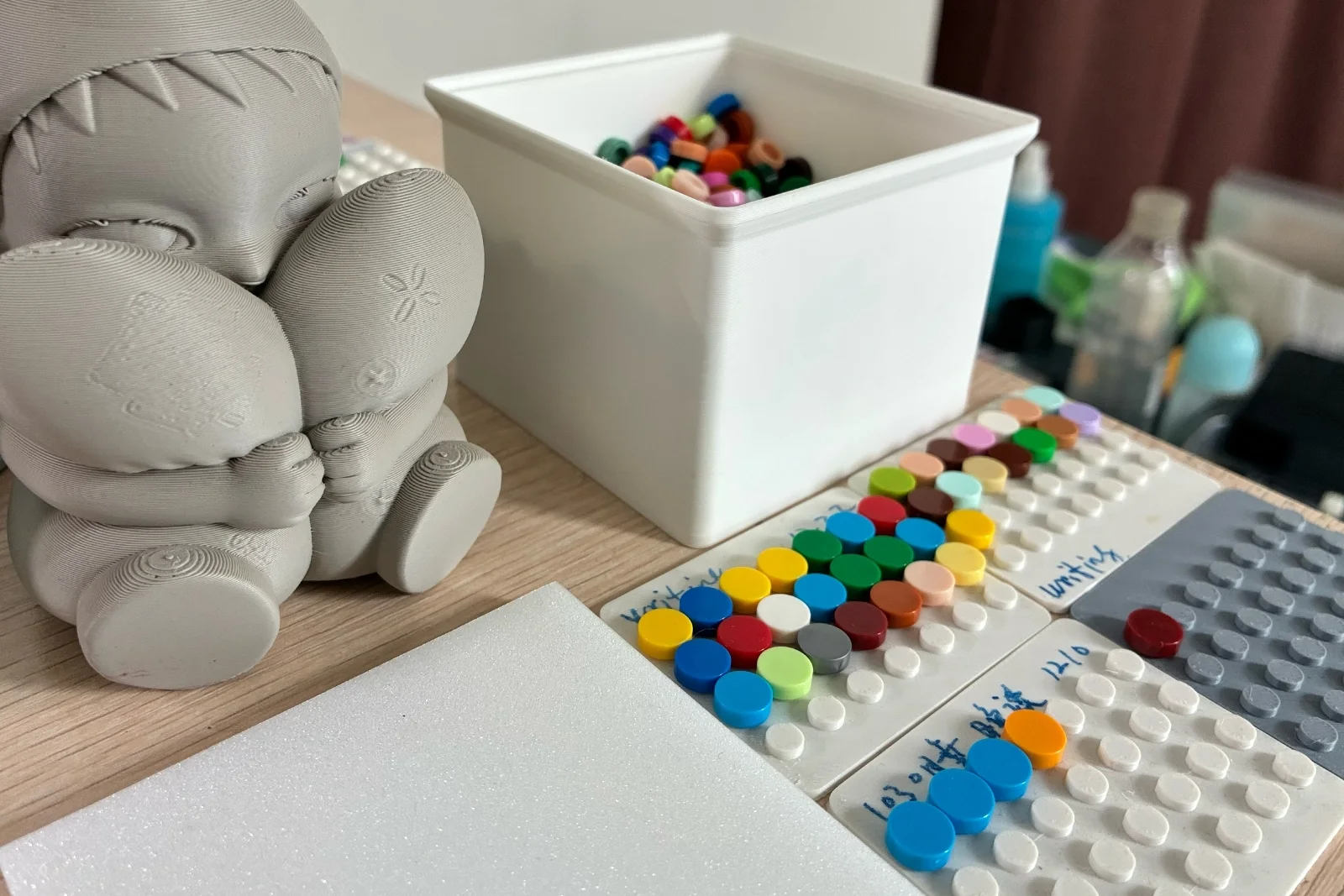
I have a LEGO baseplate on my desk. It has been there for almost a year.
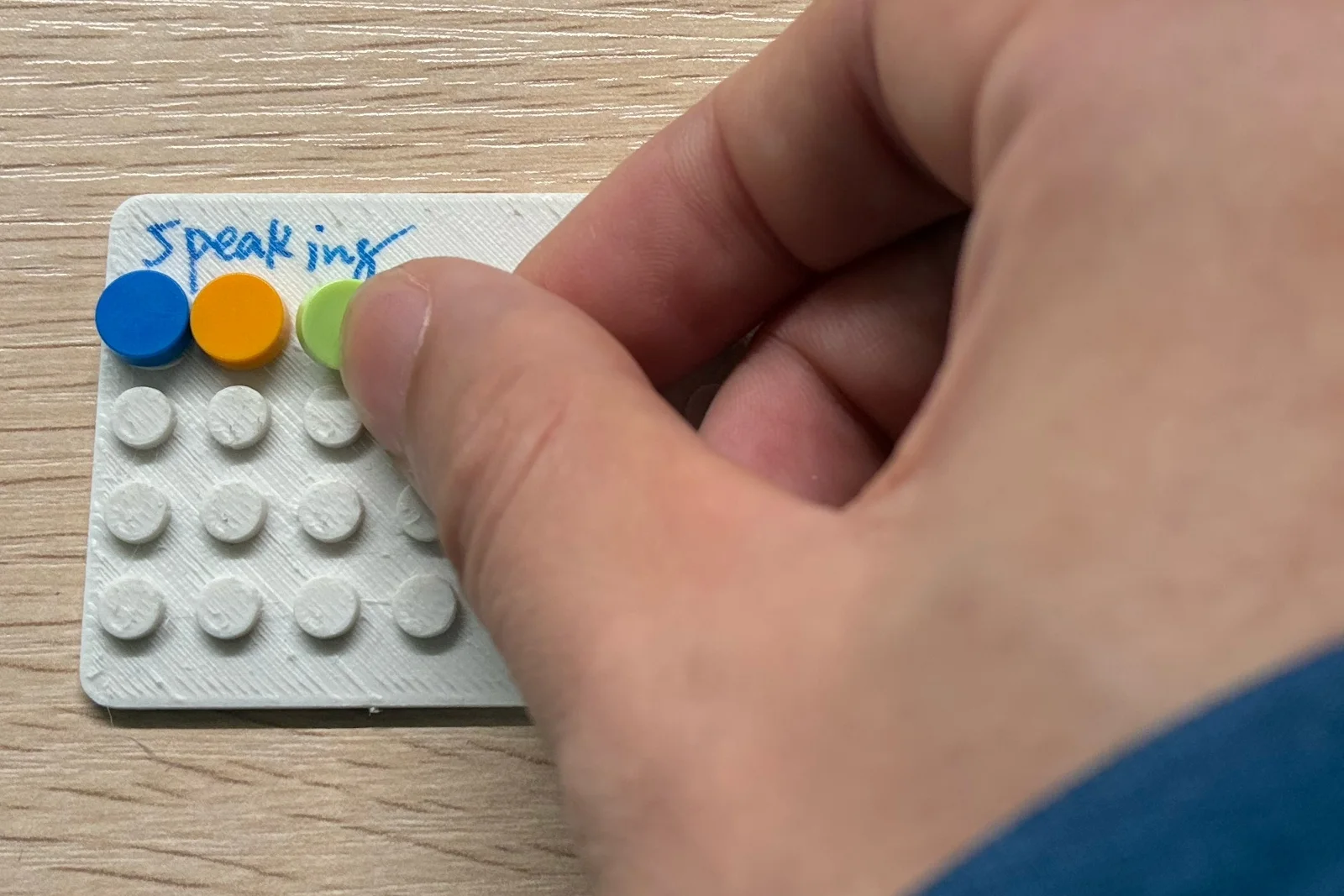
Every time I complete a focused work session, a workout, or an English study block, I snap a LEGO brick onto the plate. One brick and one click. That’s it.
There is no app involved and no tracking spreadsheet, streak counter, or weekly review. It is just a physical action that takes two seconds and cannot be undone.
I want to be specific about what “cannot be undone” means here. When you snap a LEGO brick onto a baseplate, it stays. You would have to deliberately pry it off with your fingers. There is no swipe to delete or “clear all” button, no update that resets your data. The brick is there because something happened, and something that happened cannot unhappen.
This is the entire system. I am not leaving out the clever part. Because there is no clever part.
I wake up and the baseplate is on my desk, exactly where it was yesterday, with every brick from every previous session still in place. I do not have to open anything to see my progress or remember where I left off. The physical object is the record and it does not need my attention to keep existing.
When I sit down to study English, I am not thinking about how many days in a row I have done it or whether I am on track. I do the session. When it is done, I pick up a brick and snap it on. I hear the click and feel the resistance, then the lock, and then I move on.
The click is not a reward or a gold star or a dopamine trick. It is confirmation. The world has changed by one brick.
Some weeks I study every day and some weeks I miss days. When I miss a day, nothing breaks. There is no streak to lose and no chain to rebuild or notification telling me I fell behind. The baseplate holds what happened.
Over many months, the bricks accumulated and so did small, steady changes in my English, not because the system motivated me or because I discovered new discipline, but because a system that does not collapse when you miss a day survives long enough to produce results.
The bricks did not make me study. They made studying survivable.
The LEGO system was not designed. It emerged. I started doing it almost by accident and later noticed that I had not stopped. A month passed, then three, then six. Nothing else I had tried had lasted that long.
When I tried to understand why, I kept returning to the same point. The completion lives outside my head. I do not have to believe I did it or feel that I did it. The brick is there.
This system is slow and it looks primitive. There is nothing impressive about snapping a LEGO brick onto a plate. It does not photograph well for Instagram and it does not generate charts or signal sophistication.
When I first realized this was working, I did not feel pride. I felt something closer to grief. It meant accepting that this was what I needed, not a sleek app or a complex framework. A plastic brick and a click.
For many people, digital systems work. For me, progress is a row of bricks on a desk that most people would not notice. That row has outlasted every app, every method, every system I tried before.
I will take that.
3: What It Looks Like
If you walked into my workspace, you might not notice it at first.
The baseplate sits on the right side of my desk, near the edge but not in the way. It is not centered. It is not elevated. It does not have a special stand. It rests flat on the wood surface, close enough that I can reach it without standing up.
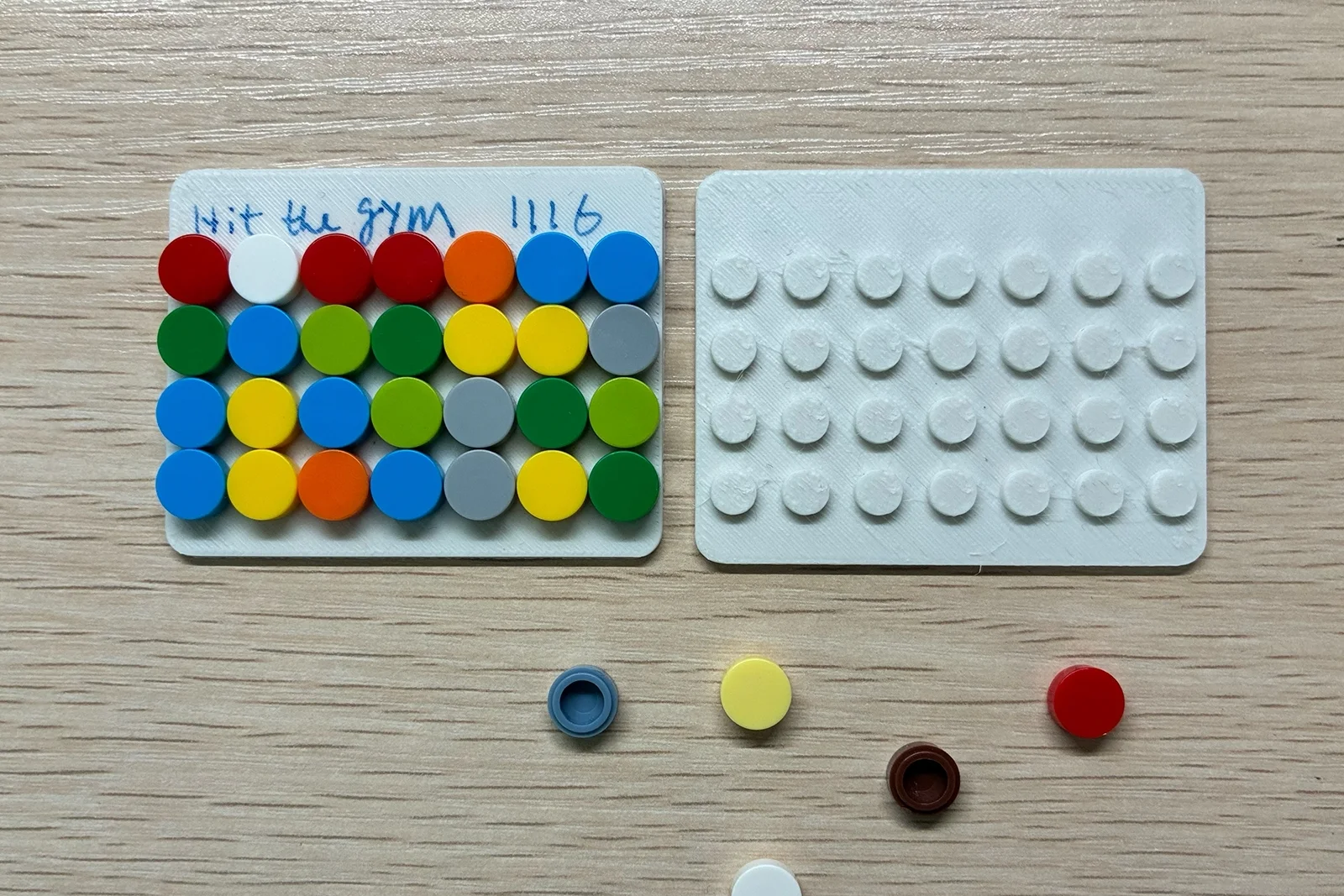
There are labels: a word written in marker on the edge of each plate. “Speaking.” “Gym.” Nothing elaborate. Early on, I also wrote dates on the front. Later, I realized that seeing the dates introduced a pressure I did not want, a timeline that invited comparison. So I moved them to the back of the plate. They are still there if I ever need them. They just do not sit in front of me anymore.
If you did not know what any of it was, you might assume it was part of a casual LEGO build that never got finished.
That is intentional.
I did not want something that looked important. I wanted something that simply stayed.
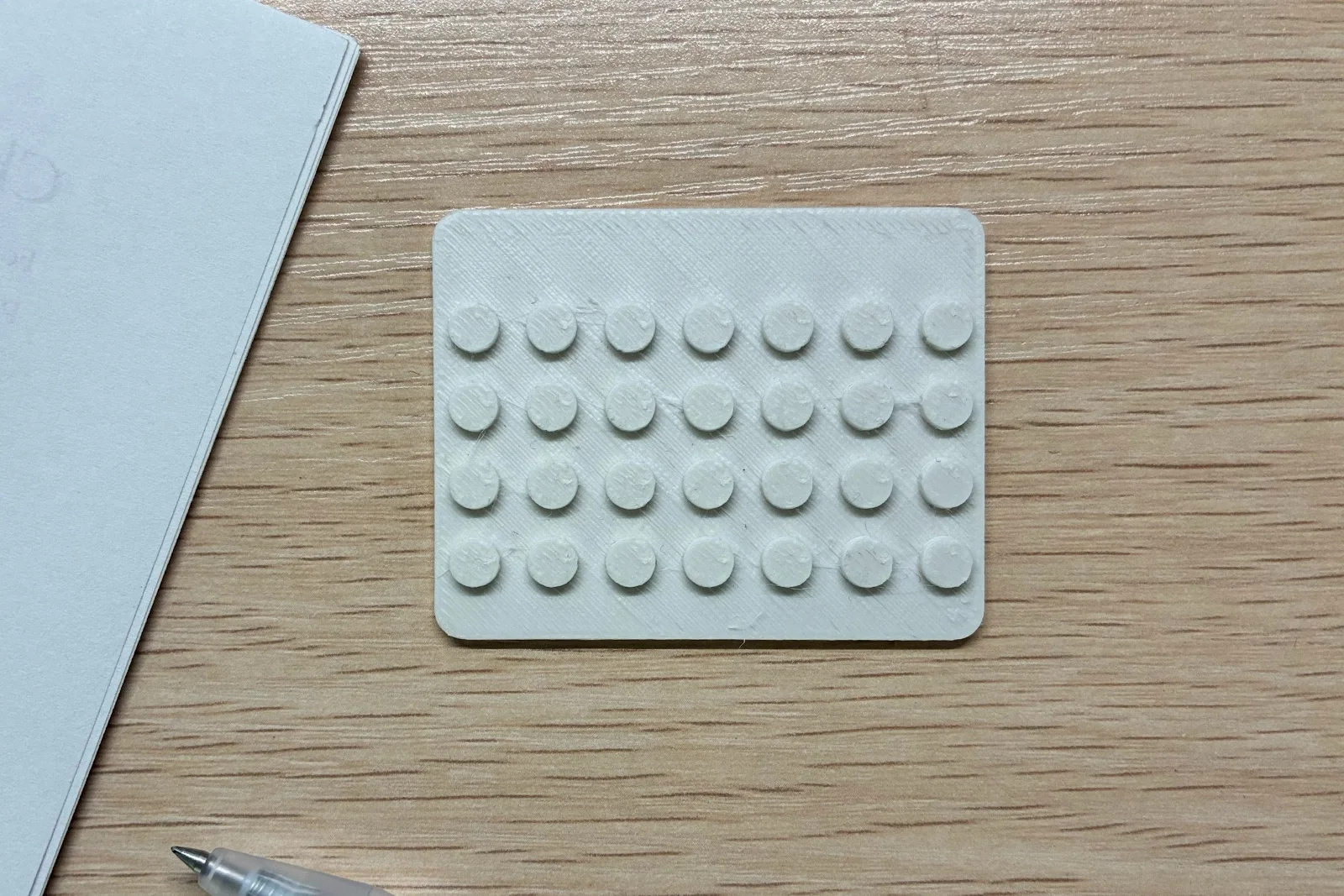
The plate itself is not store-bought. I designed it and had it 3D printed. The standard baseplates felt too thick and too large for what I needed, so I made one in a 7 by 4 format.
Each plate has only two states: full or not yet full. When a 7 by 4 plate is filled, I start another. Some plates reach that point. Some do not. A habit might pause. It might stop. It might sit there for months before I return to it. The unfinished plates remain exactly as they are.
I never go back to force them to fill up. I never rearrange them to make the sequence look cleaner. What happened stays. The rest is simply absent.
In the morning, before I open my laptop, I sometimes glance at them. Not every day. They do not demand attention. They do not flash or vibrate. They do not ask a question.
They just sit there, holding the previous months in small, quiet rectangles.
When I complete a session, whether it is focused design work, a workout, or five minutes of reading, I reach for a brick from a small container beside the plate. I press it down. There is resistance, then a small click.
The click is physical. My fingers feel the edges align. The plate settles under the pressure.
After that, there is nothing else to do. The world has changed by one brick.
4: Why I Think It Works
When I began snapping bricks onto a baseplate, I was not thinking about executive function models or dopamine pathways. I was trying to solve a simple problem: the things I did kept disappearing.
Several months into using the system, after it had already outlasted every app I had tried, I started looking for an explanation. I did not want it to feel accidental.
The research does not prove why the LEGO system works for me. It gave me a way to interpret what I had already observed.
The Signal That Wasn’t There
One of the first things I read described ADHD not primarily as a problem of attention, but as a difficulty with self-regulation. Russell Barkley’s model links behavioral inhibition with working memory, self-regulation, internal speech, and other executive functions.
The model does not use the phrase “completion signal.” That is my own name for what I experience.
I had been living with a weak completion signal for decades. I could finish something and still feel unfinished. By the next morning, I might not trust that I had done it at all. The internal voice that says “this is complete” was faint and unreliable.
Reading this research did not give me a new strategy. It clarified what had already happened.
What I had done, without realizing it, was replace the internal signal with an external one. Something that did not depend on memory or mood.
When a brick snaps onto the plate, the signal is external. It does not need my brain to sustain it.
Why the Brick Works Better Than the Screen
That still left a question. Why did a plastic brick work better than a well-designed app?
Research on embodied cognition suggests that cognition is not purely abstract. It is grounded, in part, in sensory and motor systems. Concepts can carry traces of the physical experiences that accompany them.
In one set of physics studies, students who physically experienced forces associated with angular momentum performed better on later questions. Their later reasoning also involved greater activation in sensorimotor brain regions.
That research was not about habits or LEGO bricks. It does not prove that a tactile click creates a stronger completion signal. But it helped me understand why the brick might register differently from a checkmark on a screen.
When I snap a brick onto a plate, the confirmation is not visual alone. There is pressure in my fingers, resistance in the studs, a tactile click, and a small sound. Multiple sensory channels participate in the same event.
A digital checkmark is a thinner signal by comparison. It is a small visual change on a surface used for hundreds of other interactions. For me, it blends into noise.
The Irreversibility Problem
Another piece became clearer through research on decisions that could or could not be changed.
In one experiment, participants who could not reverse a choice later reported greater satisfaction with it than participants who could change their minds. The study was not about ADHD, habit tracking, or cognitive closure. I use it as an analogy, not an explanation.
Every digital system I used left the record open to revision. I could delete the entry. Reset the streak. Remove the app entirely. That possibility kept the record feeling provisional.
A brick on a baseplate is different. It can be removed, but removal requires deliberate physical effort. The environment adds resistance. For me, that resistance helps the action feel settled.
The world has changed. The record will remain unless I actively decide to dismantle it.
Why the Rewards Stopped Working
Early in any habit app, I would feel a small surge of satisfaction. A streak climbed. A badge appeared. For a few weeks, it worked.
Then the effect faded.
One imaging study of untreated adults with ADHD found lower availability of dopamine-related markers in parts of the brain’s reward pathway. Separate research on reward prediction has shown that dopamine responses are sensitive to the difference between expected and actual outcomes.
Neither line of research tested habit apps. Neither proves why their rewards stopped working for me.
My narrower observation is simpler: streaks and badges helped while they remained salient. Once they became familiar, they faded into the rest of the interface.
The LEGO brick does not need to stay exciting. It is not designed to escalate or surprise me. It simply marks that something happened.
Facts do not need novelty to remain valid.
A System That Survives Inconsistency
Some models of ADHD distinguish between difficulties with inhibitory or executive control and difficulties related to delay aversion and motivation. Many productivity systems place pressure on both. They require executive effort to operate and promise delayed, abstract benefits.
The LEGO system seems to reduce both pressures for me.
Executive demand is minimal. Reach over. Pick up a brick. Press it down. Two seconds. The confirmation is immediate and sensory, not delayed and abstract.
More importantly, the system does not punish absence. If I miss a day, nothing fractures. There is no broken streak to repair. The baseplate continues to hold what happened.
A qualitative study of adults with ADHD documented compensation strategies such as simplifying procedures, creating special work arrangements, and adapting environments to reduce friction. It did not test this system or compare its effectiveness with internal regulation. It showed that external structuring is one of the ways adults with ADHD report working around recurring constraints.
That is what the baseplate does for me. It holds part of the structure outside my head.
Putting It Together
Looking back, my interpretation is straightforward. My internal sense of completion is unreliable. Predictable digital rewards lose their force for me. Reversible records continue to feel open, and unnecessary executive steps make a system harder to maintain.
The LEGO system does not fix those constraints. It aligns with them.
Completion lives outside my head. The record is physical and resistant to reversal. Executive demand is minimal. What accumulates is not a streak but a collection of facts. The structure asks less of the capacities I struggle to provide consistently.
The research gives me plausible language for the pattern. It does not turn one personal system into a universal prescription.
That is why I think it holds.
5: What This System Won't Do
There is no acceleration built into it. You do not level up or unlock a harder mode, and there is no multiplier for doing three days in a row. One session, one brick. The same on day one as on day three hundred.
It is not built for speed.
Over time, I realized that speed was never my real problem. The problem was that nothing lasted long enough to accumulate into anything. A slow system that survives will eventually move further than a fast system that collapses.
This is also not how digital systems typically work.
I know people who have used digital habit trackers for years and genuinely enjoy them. Their brains respond well to digital tracking, abstract rewards, and streak maintenance. Mine does not. If digital systems already work for you, you probably do not need this.
The system does not tell you what to do. It has no opinions about your goals and does not suggest habits or send reminders. It accepts a brick when you give it one, and it remains silent when you do not.
For some people, that absence might feel like a lack of structure. I understand that reaction. For me, every system that pushed eventually became something I resisted. The absence of pressure is one reason this has lasted.
It also does not eliminate bad days.
There will still be days when executive function disappears. Days when the baseplate is right there and you do not snap a single brick. That will happen. It happened to me many times this past year.
With an app, a missed day becomes visible. A broken streak or a gap in a chart signals that you fell behind. With the baseplate, a missed day looks like nothing. The bricks that are there remain. Nothing was erased and nothing needs to be repaired. You continue when you continue.
This system does not remove difficulty. It prevents difficulty from damaging the structure.
If you need something that feels like a solution, this may feel incomplete.
If you have reached the point where you would settle for something that simply does not break, this may be enough.
6: One Idea You Can Take With You
The things you do deserve a place to survive.
Not in your memory, which forgets, and not on a screen that can be reset, but somewhere physical and irreversible, somewhere that does not depend on your attention to keep existing.
For years, I thought I needed a better system or more discipline. What I was actually looking for was a way to make sure that when I did something, it stayed done, a place where my actions could accumulate instead of vanishing.
After reading the research I shared earlier, I came to understand the principle underneath. Completion is not just a feeling. It is a location. For a brain like mine, the most stable location may be a physical fact that cannot be undone.
I did not want my effort to disappear anymore.
You do not need to use LEGO bricks or anything I used. The specific object does not matter. What matters is that whatever you choose meets a few conditions: it should be physical, resistant to casual reversal, require minimal effort, and not punish you for the days you do not show up.
A marble dropped into a jar. A stamp pressed onto a page. A bead moved along a string. Anything that changes the world in a small, permanent, tangible way.
The object is not the point. The point is that you stop asking your brain to be the keeper of your own progress. For some of us, that is not a job our brain does reliably.
There is something I wish someone had told me earlier.
If every system you have tried has failed, that is not evidence that you cannot follow through. It may be evidence that the systems required a capacity your brain does not reliably provide. The failure belongs to the match, not to you.
You may need a different kind of structure. It may look slower, simpler, or less impressive than what works for the people around you. It may take time before you stop wishing you could just be normal about this.
A structure that holds is not a lesser thing. Even if it holds quietly, even if no one else notices, even if it is made of plastic bricks on a desk.
One More Brick
This booklet took almost two years to arrive. Not because it took that long to write, but because it took that long to understand what I was actually writing about.
When I was diagnosed with ADHD at 42, and later with Asperger’s at 43, it felt like being sent back to school. I read books. I studied research papers. I tried to trace my own patterns and match decades of lived experience to frameworks I had never known existed. The LEGO system was one discovery along the way. The larger work was quieter and more complicated. I was learning how to read myself.
At some point, the searching slowed down. Not because there was nothing left to learn. The urgency simply eased. The diagnosis stopped feeling like something I had to recover from. The questions I had carried for years began to loosen: Why am I like this? What is wrong with how I work? Why can I not do what others seem to do? The answers were not perfect, but they were steady enough.
This booklet is where I let that understanding settle.
I wanted to place it somewhere outside my head. When something stays internal, it remains fragile. When it rests somewhere real, it becomes fact.
Writing this feels less like a graduation and more like a natural pause. Not from ADHD. That is simply how my brain works. It is a pause from the constant measuring, analyzing, and comparing myself against every model I could find. That phase has eased.
The booklet exists. That is enough.
I can move forward knowing myself a little more clearly. Not completely. Just enough.
One more brick. Snap. Done.
- Louis Li
The Inspiration
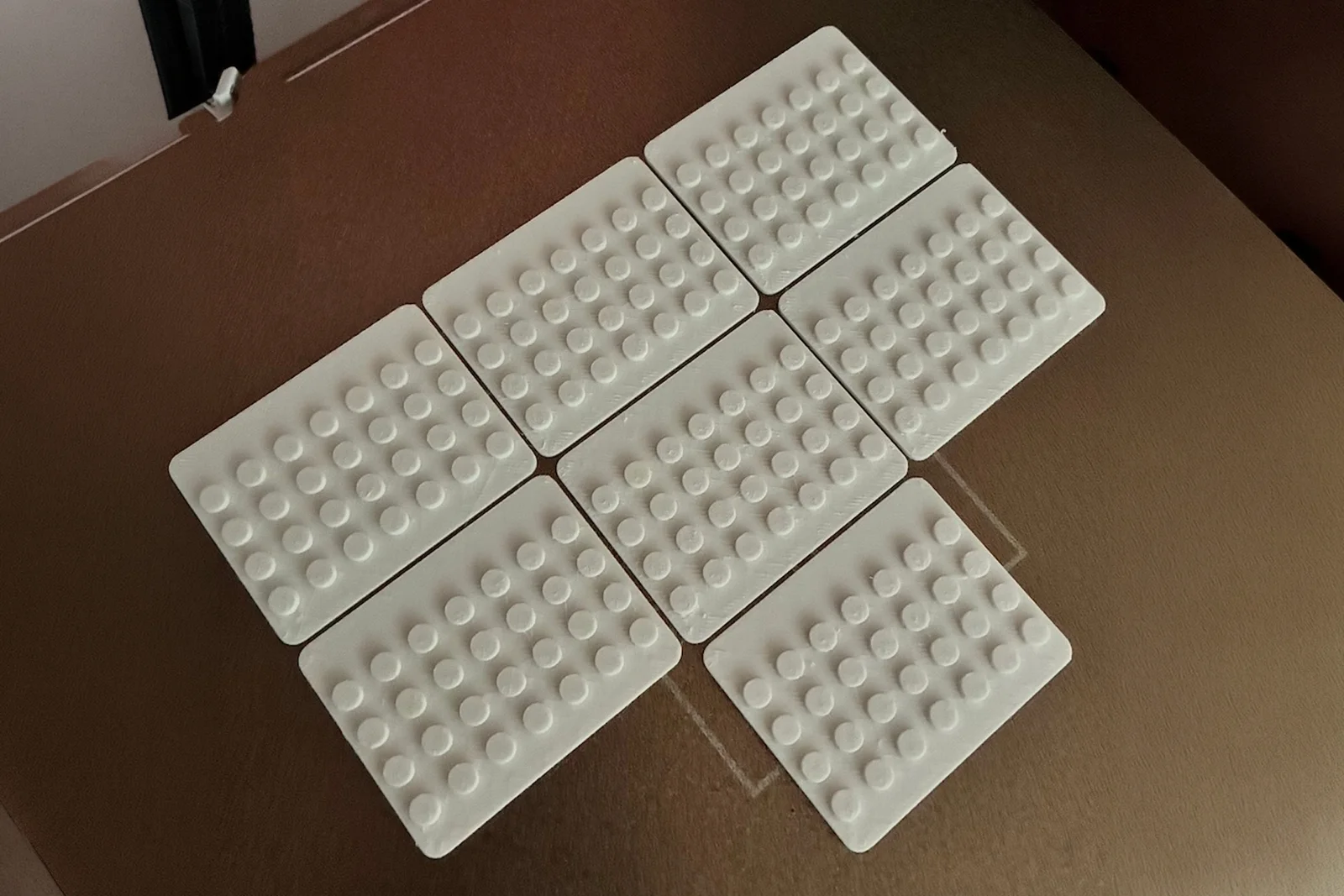
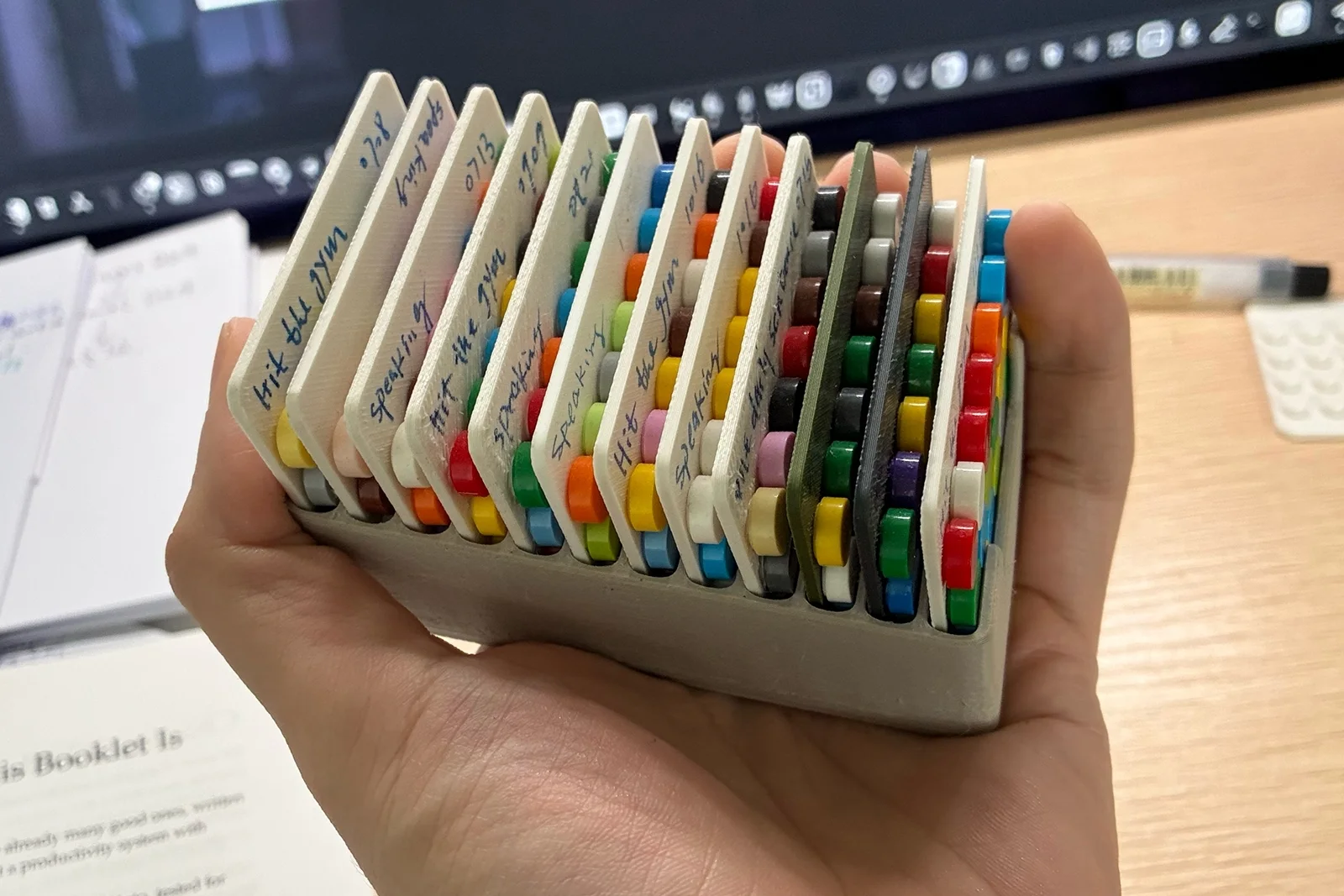
When a plate is full, it goes into a container I designed once I realized I needed somewhere to put the finished ones. The inspiration came from Dexter’s slide box. Depending on how you look at it, that is either a worrying reference or a perfectly logical one.
References
Barkley, R. A. (1997). Behavioral inhibition, sustained attention, and executive functions: Constructing a unifying theory of ADHD. Psychological Bulletin, 121(1), 65-94.
Barsalou, L. W. (1999). Perceptual symbol systems. Behavioral and Brain Sciences, 22(4), 577-660.
Canela, C., Buadze, A., Dube, A., Eich, D., & Liebrenz, M. (2017). Skills and compensation strategies in adult ADHD: A qualitative study. PLOS ONE, 12(9), e0184964.
Gilbert, D. T., & Ebert, J. E. J. (2002). Decisions and revisions: The affective forecasting of changeable outcomes. Journal of Personality and Social Psychology, 82(4), 503-514.
Kontra, C., Lyons, D. J., Fischer, S. M., & Beilock, S. L. (2015). Physical experience enhances science learning. Psychological Science, 26(6), 737-749.
Schultz, W. (1998). Predictive reward signal of dopamine neurons. Journal of Neurophysiology, 80(1), 1-27.
Sonuga-Barke, E. J. S. (2002). Psychological heterogeneity in AD/HD: A dual pathway model of behaviour and cognition. Behavioural Brain Research, 130(1-2), 29-36.
Volkow, N. D., Wang, G.-J., Kollins, S. H., Wigal, T. L., Newcorn, J. H., Telang, F., et al. (2009). Evaluating dopamine reward pathway in ADHD: Clinical implications. JAMA, 302(10), 1084-1091.